





Exceptional trees - Sycamore Gap
The much maligned sycamore tree (Acer pseudoplatanus) has never received much admiration since its introduction to England in the fifteenth century. Even before it became widely distributed, gardener, writer, and minor government official John Evelyn (1620-1706) was castigating it saying 'The Sycomor is much more in reputation for its shade than it deserves; for the honey-dew leaves, which fall early (like those of the Ash) turn to a mucilage and noxious insects, and putrifie with the first moisture of the season; so as they contaminate and marr our walks; and are therefore by my consent, to be banished from all curious gardens and avenues’.
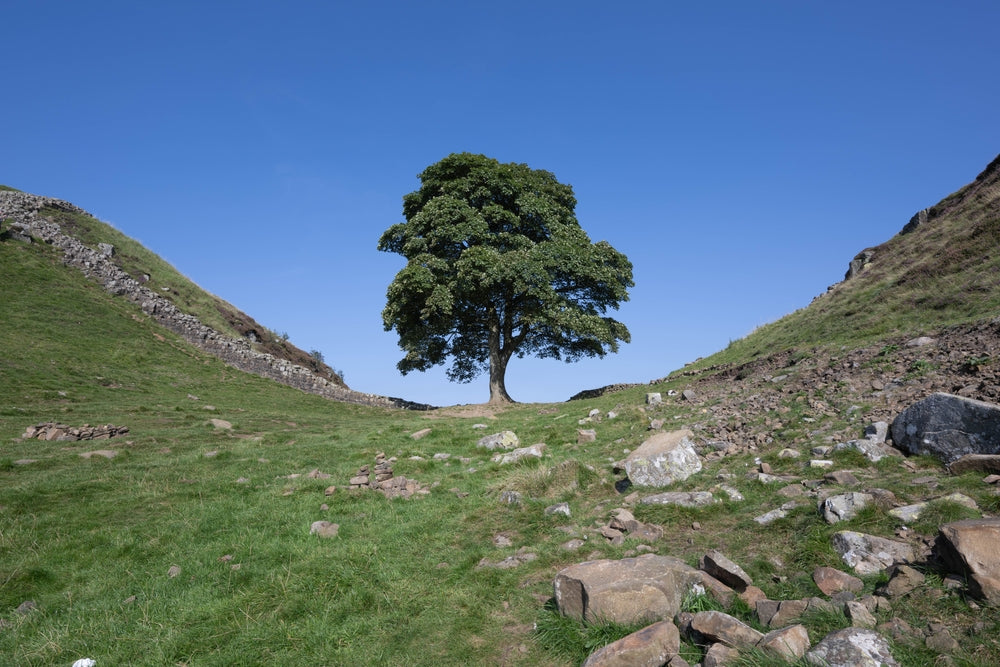
To this day the sycamore, despite its impressive stature, has something of a reputation as a weed, its winged helicopter seedlings filling any vacant gap in beds, borders, pots, and paving. Despite all this, one particular tree has caught the public’s imagination. Gardeners and non-gardeners alike had a love for a sycamore that made its home in a glacial dip alongside Hadrian’s Wall that marks the boundary between historic Roman Britannia and unconquered Caledonia to the north.
Known as The Sycamore Gap Tree or The Robin Hood Tree it is considered the most photographed tree in the country and has become an icon for the North-East of England. Perhaps ‘had become an icon’ should be the correct term, for in September 2023 it was felled in an act of vandalism which made headlines throughout the world. The tree planted in the late 19th century had stood for 150 years and was featured in films including Robin Hood Prince of Thieves, a Bryan Adams music video and several series for television. Felled by chainsaw - the noise unnoticed by locals due to passing storm Agnes - two alleged perpetrators have pleaded not guilty to an act of criminal damage. A trial of the men is scheduled for December 2024.
There is optimism that the tree will send up new growth from the ‘coppiced’ parent and seeds collected from the site have been sown and are in the care of the National Trust. A small number of new saplings have done well and the first seedling to arise from the sowing was presented to The King to be planted in Windsor Great Park when it has matured into a sizeable specimen.


