








Overnight appearance - Iris reticulata
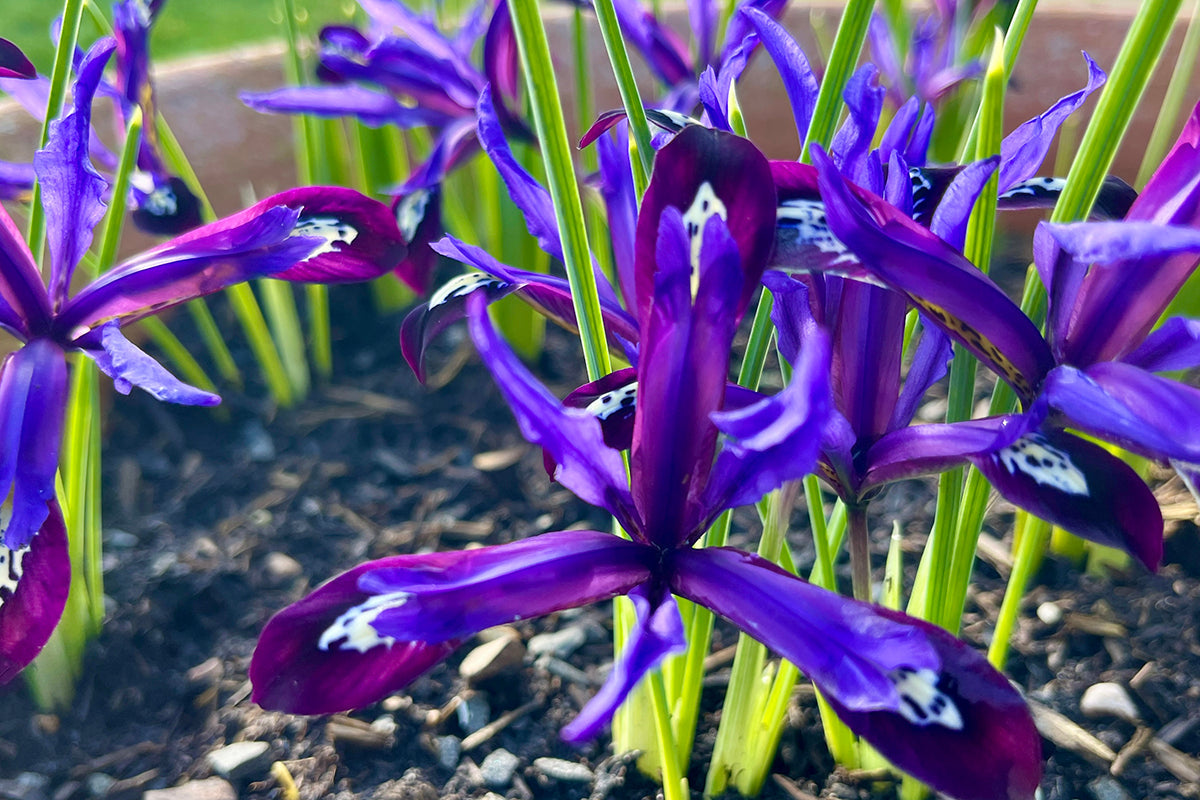
It happened overnight. Or at least that what it felt like. We'd spent a day rearranging the spring pots - all had showed signs of life but flowers were conspicuous by their absence. Subsequently, a few days of bad weather kept us from the garden but on our next venture to the greenhouse we were stopped short, all pots were sporting a crown of bright purple-blue flowers. Iris reticulata ‘Blue Note’ had arrived!
Planted three years previously it was wonderful to see them appear again - our first blue for the year. The reticulata irises perhaps better known as dwarf irises, are very different to their extravagant blowsy summer cousins, the bearded irises. Available as small bulbs, dwarf iris are cheap to purchase enabling them to be used generously in containers and borders. Colour choice is a little limited, leaning towards the blues and purples, but whites and creams are available too.
In one of the borders we have a very pale blue variety ‘Katherine Hodgkin’. Introduced in 1958 by E. B. Anderson it was named after the wife of bulb enthusiast Eliot Hodgkin. We have our eye on dark-blue to almost black ‘Blue Note’ and white ‘North Star’ for next year. With the RHS Plant Finder listing over 50 options we wouldn’t like to choose for you but selecting next year's variety makes for an enjoyable hour or two while the rain batters against the study window.


